
Historical background
The presence of the Barbera variety in the Alba area dates back to the second half of the 1600s, when some cuttings transplanted from the Asti area were introduced. The period of greatest diffusion was around 1860-1870 as documented by Lorenzo Fantini in his “Monograph on Viticulture and Oenology in the Province of Cuneo”. The variety proved particularly successful following the replanting of vineyards on American rootstock due to phylloxera, proving resistant and productive.
Production Area
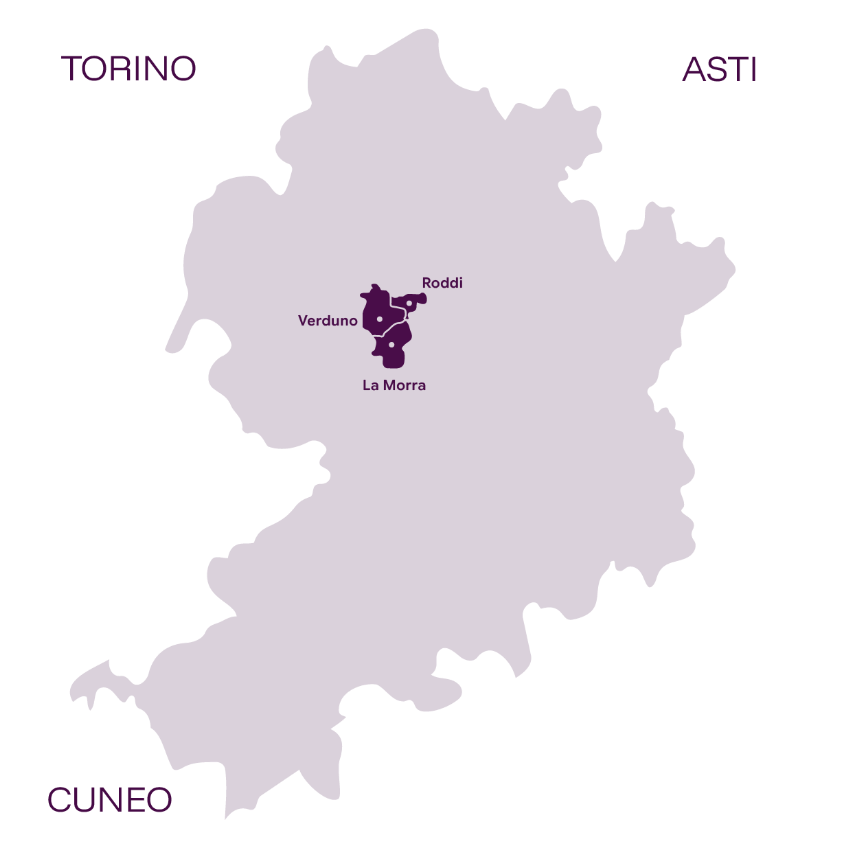
The grapes intended for the production of wines with the designation of origin “Barbera d’Alba” must be produced in the area of origin comprising the entire territory of the municipalities of: Alba, Albaretto della Torre, Barbaresco, Barolo, Borgomale, Camo, Canale, Castagnito, Castellinaldo, Castiglione Falletto, Castiglione Tinella, Castino, Corneliano d’Alba, Cossano Belbo, Diano d’Alba, Govone, Grinzane Cavour, Guarene, Magliano Alfieri, Mango, Monforte d’Alba, Montelupo Albese, Monticello d’Alba, Neive, Neviglie, Novello, Perletto, Piobesi d’Alba, Priocca, Rocchetta Belbo, Roddi, Roddino, Rodello, S. Vittoria d’Alba, S. Stefano Belbo, Serralunga d’Alba, Sinio, Treiso, Trezzo Tinella, Verduno, Vezza d’Alba; and partially from the territory of the municipalities of Baldissero d’Alba, Bra, Cortemilia, Cherasco, La Morra, Monchiero, Montà d’Alba, Montaldo Roero, Monteu Roero, Narzole, Pocapaglia, S. Stefano Roero and Sommariva Perno.
Characteristic
Barbera d’Alba is a wine rich in colours that generally evoke purplish ruby; the aroma is broad and complex, with fruity notes that recall blackberry, cherry, strawberry and red fruit jam, and spicy hints that evoke cinnamon, vanilla and green pepper. The flavour, full-bodied, attenuates the typical acidity characteristic of the variety. Small barrels are used with good results, suitable for this type of wine, precisely because they too soften the acidity which – it should be noted – remains fundamental to the balance of taste of the product and to good, pleasant drinkability and digestibility. In recent years, Piedmontese Barbera has gained the esteem of the public because it has proved capable of offering, through appropriate winemaking processes, both excellent ready-to-drink wines and medium-longevity wines with good structure that stand the test of time and confirm, after many years, the most original characteristics of a land and a variety of particular prestige.